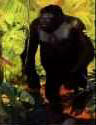
 During
the late 1970s and throughout the 1980s the State of Florida was the setting
for a series of encounters between people and a Bigfoot like creature that
soon came to be known as the Skunk Ape. The name arose due to the animals
supposed ape-like appearance and its odor which was described as being similar
to that of a skunk.
During
the late 1970s and throughout the 1980s the State of Florida was the setting
for a series of encounters between people and a Bigfoot like creature that
soon came to be known as the Skunk Ape. The name arose due to the animals
supposed ape-like appearance and its odor which was described as being similar
to that of a skunk.
The first of these sightings occurred in Marion County in 1977. Thereafter, sightings occurred in Lake County in 1980, in Broward County in 1980, in Citrus County in 1983, in Volusia County in 1989, and in Collier County in 1993 and 1997. Some of these sightings were only of footprint evidence although several of the witnesses claimed to have seen the animal itself.
The most recent, and interesting, of these sightings took place in Collier County in the Big Cypress National Preserve on July 16th, 18th, 21st, and 24th. Witnesses included the local fire-chief, two tour guides and their tour buses filled with tourists, a local realtor, and a young couple.
The town of Ochopee is located 60 miles West of Miami and 30 miles east of Naples in the Big Cypress National Preserve, a portion of the Everglades which is considered a Wildlife Management Area. (Hunting and fishing are allowed in Big Cypress.) The tiny town is home to only a handful of residents.
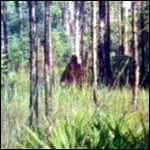 The
first sighting occurred on July 16th when a tour guide and his clients observed
a large, reddish-brown animal standing near a burned out bride on the west
side of Turner River Road behind some cypress trees. The animal reportedly
looked agitated as it was shaking the branches as if to drive the people off.
The tour guide drove off after a while to get his camera. When he returned
the animal was gone and no signs of it could be found. (None of the tourists
could be persuaded to disembark the bus to photograph the creature.)
The
first sighting occurred on July 16th when a tour guide and his clients observed
a large, reddish-brown animal standing near a burned out bride on the west
side of Turner River Road behind some cypress trees. The animal reportedly
looked agitated as it was shaking the branches as if to drive the people off.
The tour guide drove off after a while to get his camera. When he returned
the animal was gone and no signs of it could be found. (None of the tourists
could be persuaded to disembark the bus to photograph the creature.)
Subsequent sightings included another group of tourists, the fire-chief (who took the only photograph of the animal at a distance of approximately 100 yards with a camera he keeps in his car to photograph accident scenes), a local realtor who believes in the existence of the Skunk Ape, and a young couple who had been observing wildlife in the area.
The Arguments
Without getting too detailed about the credentials of the witnesses I would like to examine the evidence for and against the validity of these sightings.
Evidence which exists to validate the sightings includes: The photograph taken by the chief; the number of the witnesses and their varied backgrounds; the track castings which were taken by David Shealy, the owner of the Panther Gift Shop; and one pile of unidentified feces. Some, including myself, have raised questions as to the sanity of anyone who would be foolish enough to don a fur costume and stomp around in Big Cypress so close to hunting season waiting to be shot by a frightened local.
One possible explanation of the animals movement from East to West is that it was fleeing the wet areas of Big Cypress in favor of higher, and drier, ground.
Arguments against the validity of the sightings include: The fact that two (2) tour-buses observed the creature two days apart, eliciting claims that it was a hoax specifically targeted towards the tourism industry; the fact that the track casts are of two left feet; and the fact that the feces could conceivably be from a black bear. (Fecal analysis yielded berries, plants, and small animal bones.)
The "Experts"
The local CBS affiliate did an "investigative report" on the sightings which aired in two parts on Halloween and the day after in South Florida. Two "experts" were recruited for the investigation. These experts were The Amazing Randi, well known skeptic, and Ron Magill, spokesperson for Miami’s Metrozoo. Both of them discounted the footprint casts as fakes since there were two left foot casts. Each also expressed a great deal of skepticism when asked about the possibility of a large undescribed animal living in the swamp of southwest Florida.
No anthropologists or zoologists were consulted for this report, Mr. Magill being a spokesperson rather than an academician and having no educational background to speak of in zoology. Thus the objectivity of the investigation is questionable.
Dr. Grover Krantz has seen photographs of the casts and of the sighting locations taken by this investigator and has indicated that the environment surrounding the sighting areas looked good. He reserved judgment on the casts, wanting to see copies first-hand, but indicating that reports of four-toed prints were quite common in the Eastern United States.
Personal Questions
Several nagging questions have followed me throughout my contact with the locals and my investigation of the incidents. Most of these revolve around the statements made by David Shealy.
The first inconsistency has to do with two crossed sticks forming an "X" on the side of the road where the fire-chief took his photograph. When questioned by the reporter, the fire-chief indicated that he had not placed the sticks there. However, when Mr. Shealy was asked by this investigator "who put the sticks there?", he said that it was the fire-chief.
The second inconsistency is in regards to the footprint casts. When interviewed by the reporter Mr. Shealy indicated that the tracks were found "side by side". When questioned by the investigator Mr. Shealy indicated that the tracks were found several yards apart.
Finally, Mr. Shealy has been unwilling to relinquish copies of the footprint casts up to this point, but has promised this investigator that, during my next visit to Ochopee casts may be made and forwarded to whatever experts I choose.
Conclusions
No one in Ochopee is really willing to say that what they saw was the Skunk Ape, although the realtor indicated that she does believe in the animal, but does not fear it. In fact, she indicated that when her children were young they would often describe such an animal to her and say that they had seen it around the family property.
After speaking to the investigative reporter from the television station for some time I learned several interesting things, none of which I feel compelled to divulge at this time, which further indicate to me that the whole affair may have been an elaborate hoax designed to attract tourists to the area. I will, however, reserve judgment at this time, preferring to continue the investigation in the hopes of turning up more concrete evidence.
For now, let it suffice to say that no one is sure whether or not the Skunk Ape exists in South Florida, and if it does, whether or not it was what the witnesses saw on those hot and humid days in July.
I would like to thank
my dear friend Bobbie Short for asking me to write this story for her web-site.
CK, Florida November 1997